A Tale of Two Jars
Blog post description.
4/7/20267 min read

John 4:4-29
And he had to pass through Samaria. So he came to a town of Samaria called Sychar, near the field that Jacob had given to his son Joseph. Jacob’s well was there; so Jesus, wearied as he was from his journey, was sitting beside the well. It was about the sixth hour.
A woman from Samaria came to draw water. Jesus said to her, “Give me a drink.” (For his disciples had gone away into the city to buy food.) The Samaritan woman said to him, “How is it that you, a Jew, ask for a drink from me, a woman of Samaria?” (For Jews have no dealings with Samaritans.) Jesus answered her, “If you knew the gift of God, and who it is that is saying to you, ‘Give me a drink,’ you would have asked him, and he would have given you living water.” The woman said to him, “Sir, you have nothing to draw water with, and the well is deep. Where do you get that living water? Are you greater than our father Jacob? He gave us the well and drank from it himself, as did his sons and his livestock.”
Jesus said to her, “Everyone who drinks of this water will be thirsty again, but whoever drinks of the water that I will give him will never be thirsty again. The water that I will give him will become in him a spring of water welling up to eternal life.” The woman said to him, “Sir, give me this water, so that I will not be thirsty or have to come here to draw water.”
Jesus said to her, “Go, call your husband, and come here.” The woman answered him, “I have no husband.” Jesus said to her, “You are right in saying, ‘I have no husband’; for you have had five husbands, and the one you now have is not your husband. What you have said is true.” The woman said to him, “Sir, I perceive that you are a prophet. Our fathers worshiped on this mountain, but you say that in Jerusalem is the place where people ought to worship.” Jesus said to her, “Woman, believe me, the hour is coming when neither on this mountain nor in Jerusalem will you worship the Father. You worship what you do not know; we worship what we know, for salvation is from the Jews. But the hour is coming, and is now here, when the true worshipers will worship the Father in spirit and truth, for the Father is seeking such people to worship him. God is spirit, and those who worship him must worship in spirit and truth.”
The woman said to him, “I know that Messiah is coming (he who is called Christ). When he comes, he will tell us all things.” Jesus said to her, “I who speak to you am he.” Just then his disciples came back. They marveled that he was talking with a woman, but no one said, “What do you seek?” or, “Why are you talking with her?” So the woman left her water jar and went away into town and said to the people, “Come, see a man who told me all that I ever did. Can this be the Christ?”
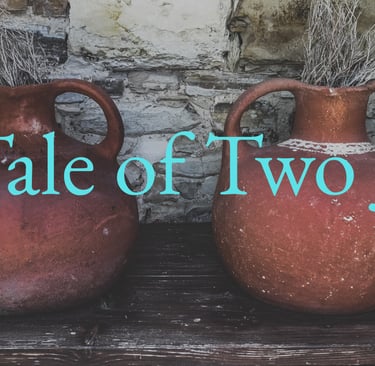
The Tale of the First Jar
In this passage we will consider a portion of the many truths to be gleaned therein; however, it is important to be reminded of the entire event and the full context of this important conversation at Jacob’s well. Notice first the statement of verse four that assures us it was necessary for Jesus to pass through Samaria. He was travelling from the Judean countryside near Jerusalem to Galilee, and when you look at a map of the area during this time, you can easily determine that He had to go through Samaria if he planned his route “as the crow flies.”
We must realize however, that the Jews had no dealings with Samaritans at all. In fact, no one would associate with Samaritans. They were complete outcasts in the world. For the Jew it was even worse because people of Samaria would make them unclean and necessitate a complicated process of cleansing to be eligible for prescribed feasts and means of worship and atonement. Therefore, courses for journeys between Judea and Galilee circumvented Samaria all together. These were the safest, most common, and well-travelled routes and were far superior to the primitive paths one would be forced to use to proceed straight through that country.
And yet we are assured by the Word that Jesus had to pass through Samaria. It was certainly not a geographical strategy that influenced this band of devout Jewish men to sully the soles of their feet with the soil of this shameful nation. No. Jesus had to pass through Samaria because He was determined to keep a divine appointment in Sychar with an outcast woman in a nation of outcast people. He had to pass through Samaria to get to her. It has always been His divine, loving nature to get to us regardless of the extreme situations we are in.
It was when He was alone that she came. At the height of the sun at noonday when she was sure there would be no one else there, she brought her empty jar to the well. This was the daily routine: bring the empty vessel to be filled only to have it emptied by the next morning. Rinse and repeat: day after insignificant, unchanging day. And it was here, of all places and of all times, that she met Jesus. It was here that she encountered the source of Living Water and eternal life along with meaning and purpose and a new message: “Come see!” She finally found the man she had been searching for her whole life and left her perpetually empty jar behind.
Life is often just exactly like that. We find ourselves running around with empty jars and filling them repeatedly with things that cannot compete with what we are really searching for. Instead, we saturate them with material goods and wealth, promotion and success, carnal desires and emotional affirmation. The movie “Click” with Adam Sandler, released in 2006, puts a remote in the hands of an ambitious man who uses it to skip ahead in life to events he is sure will fill his own empty jar. The results are predictably disastrous.
Even though we may never think to bring our empty hearts to Jesus, He will move Heaven and earth to get to us. He finds us even as we are making more feeble attempts to fill our lives with something that will finally prove to be truly meaningful and valuable. He brings with Him what we have been seeking: an eternal family, a place to call home, a noble purpose, a hope, and a future. When we drop our emptiness at His feet He fills us to overflowing with what will never run out, rust, or corrupt.
Mark 14:3-9
And while he was at Bethany in the house of Simon the leper, as he was reclining at table, a woman came with an alabaster flask of ointment of pure nard, very costly, and she broke the flask and poured it over his head. There were some who said to themselves indignantly, “Why was the ointment wasted like that? For this ointment could have been sold for more than three hundred denarii and given to the poor.” And they scolded her.
But Jesus said, “Leave her alone. Why do you trouble her? She has done a beautiful thing to me. For you always have the poor with you, and whenever you want, you can do good for them. But you will not always have me. She has done what she could; she has anointed my body beforehand for burial. And truly, I say to you, wherever the gospel is proclaimed in the whole world, what she has done will be told in memory of her.”
The Tale of the Second Jar
There was another woman, but this one came looking for Jesus. She hoped to find Him alone in a private moment, for what she had planned was a foolish idea on its face. She knew that her actions would more than likely elicit criticism and derision from any witnesses bringing embarrassment to her and to Jesus. The idea seemed absurd enough to her without the presumed public humiliation, but her heart was steadfast and she was determined to go through with her endeavor regardless of any shame that may attempt to attach itself.
Her jar was not empty, but full. It was not made of ordinary clay, but of handcrafted alabaster, elegantly fabricated and a treasured piece of art. It was laden with precious oil of pure nard painstakingly synthesized from a rare Himalayan plant. The modern equivalency of its total value lay between $50,000 and $60,000. It was fashioned and filled over years.
She found Jesus in the worst of circumstances as far as she was concerned. He was not alone but reclining at a table surrounded by men in a prominent home. But she remained resolute in her purpose, there was no turning back now. She quickly approached Jesus and without hesitation destroyed her jar ruining it for any further use. Then she lavished the treasured contents upon His head, anointing Him with her extravagant offering of worship and honor.
Her predictions of adverse reactions proved true as she was met with indignance, resentment, and denunciation. She was verbally abused and scolded for wasting such a priceless possession on Jesus for a singular expression. She did not, however, anticipate His response: “Leave her alone. What she has done for me is beautiful. She has done everything she could for me, and no one will ever forget this moment.”
Two Jars: One Story
You see, when Jesus finds us, He takes our emptiness in exchange for His precious eternal gift of grace and love. We are finally filled. No more running around with empty jars in never-ending circles of fruitlessness. Now we bring our lives back to Him, full to overflowing with gratitude and praise, and we break ourselves before Him in worship and honor, spilling out all that we have and all that we are upon Him. Regardless of what others may do or say, we show extravagant love without shame, holding back nothing.
Two jars: one is a wasteful life leading nowhere and the other a life of Spirit-filled purpose offered back to Jesus without reservation or restriction. To possess the latter, we are required merely to let go of the former in abandoned trust and faith. The trade-off is a bountiful yield of joy, hope, purpose, family, and eternal life.
Connect
Larry@everydaygracematters.com
© 2025. All rights reserved.