After the Restoration: Step One, Deny Yourself
Blog post description.
6/29/20265 min read
The Transformation Invitation:
Follow Me
The invitation to live as new creations in the Kingdom of our Lord and of His Christ is for right here and right now. No more delay. No more debate. It is time to deliver a hearty and heart-felt “Yes, Lord,” and begin this new discipleship journey. Every journey, of course, begins with a single step, and the first step is always crucial. It sets our direction and measures our enthusiasm for the road ahead. No one breaks the tape coming out of the starting blocks, and the course laid out ahead will not be brief, nor will the way beneath our feet always be smooth and steady. Before we can finish well, we need to begin in the same way. And that way, according to our Leader, is, “Let him deny himself.”
What Is Self-Denial?
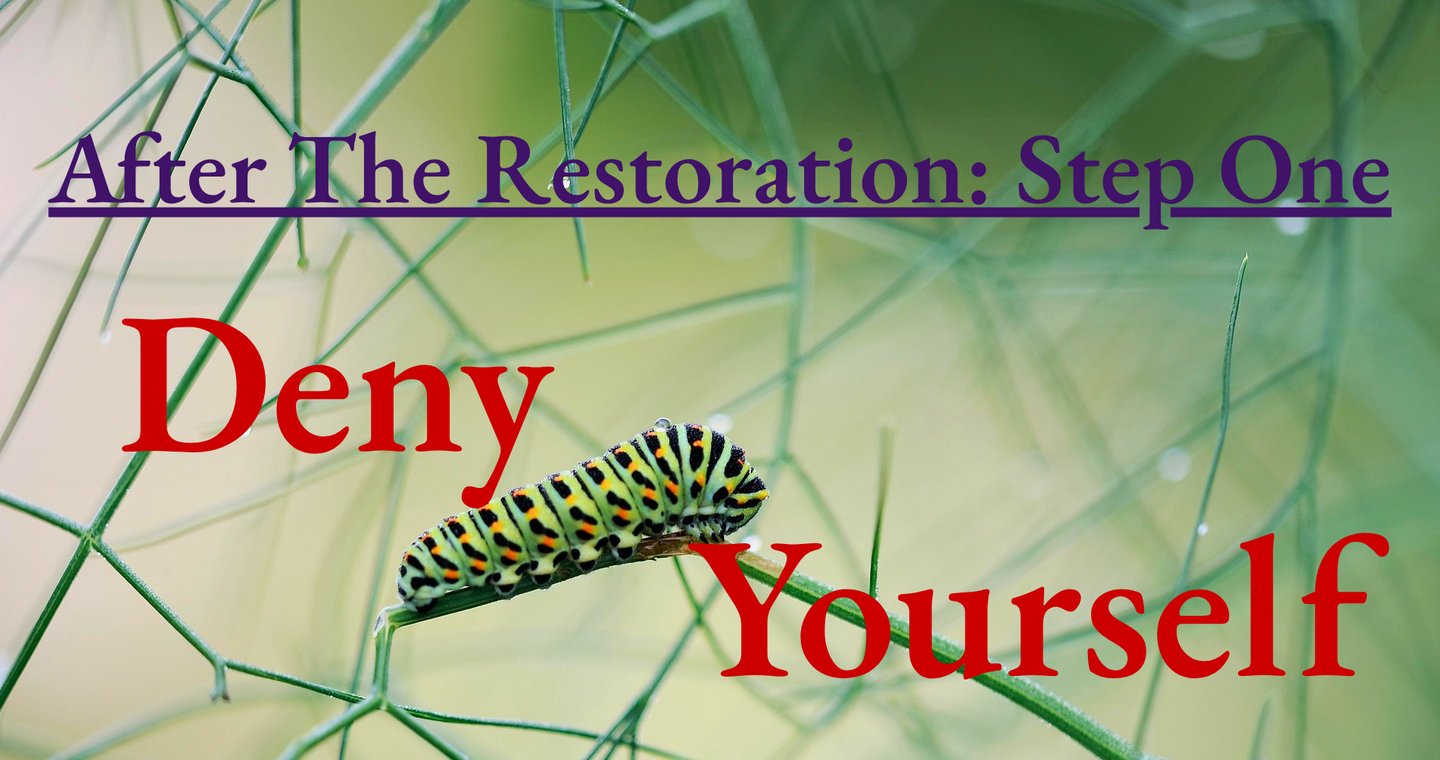
The Greek words translated for us as “deny self” mean to disown, renounce, and refuse to associate with self-will, self-interest, and self-centered living. To deny oneself is to completely lose sight of and contact with oneself. This makes a great deal of sense when we consider that butterflies never associate with caterpillars. Butterflies do not even remember ever being caterpillars. And this explains exactly why step one is critical to get right.
Imagine a butterfly attempting to cling to anything in its caterpillar past. How strange it would be to see a magnificent Monarch crawling across the sidewalk or chewing on foliage. When we deny ourselves, we refuse to hold on to caterpillar behavior in any manner: thinking, behaving, or living. The alternative is to waste those beautiful new wings and the ability they provide for us to fly freely from flower to flower propagating new life in the pollination process. “The old has passed away” is prerequisite to “the new has come.”
Many Christians have sadly interpreted self-denial as a sort of self-hatred. They often see a picture that portrays a miserable existence of obeyance that makes suffering our goal. But Jesus is not calling us to self-loathing, He is calling for our surrender. He never teaches us to deny our personalities, our unique talents, or our needs. Conversely, He encourages us to make these things matters of prayer, service, and spiritual growth. Jesus tells us that abandoning self as the center of life is mandatory in the Kingdom of God. We accomplish this as we willingly resign our personal ambitions, comforts, rights, and autonomy in full submission to Jesus Christ so that we may follow Him.
American Thinking Versus Kingdom Thinking
There are a couple of issues that those of us raised in this great country of the U.S.A. need to deal with right away. The first issue is that of surrendering our individual rights. After all, we fight and die for our rights in this nation. But standing for moral rights can be confusing and lead to a sense of entitlement beyond the scope of bravely defending the values we hold dear. A disciple does not demand what he thinks he may deserve. Instead, he makes the choice to trust God for truth and authentic goodness in his life.
The second issue problematic in killing off that old caterpillar and learning to fly is the idea that submission equals weakness. When Godly marriage relationships are discussed, this is always a dilemma. If this definition were correct, it would be no wonder that wives think they are getting a raw deal. To be in submission to another is not weakness. Jesus, our example, is in perfect and continual submission to the Father and His deference cannot be construed as fragility. It is through His submission, even to death on a cross, that Jesus has been exalted to the highest place and been given a name above every other. It is therefore our privilege to bow in worship and confess His lordship both now and forever. And so shall it be for every person who has ever existed, whether they chose to do so willingly while living in God's creation, or by force of inevitable justice that awaits us all.
Self-denial is not an option for the determined disciple, and it is not attained in pieces and parts nor fits and starts. It is the ultimate “all or nothing” proposition. The caterpillar version of yourself cannot lead you in the paths of Jesus and into eternal life with Him. Laying it aside, we escape from the cocoon and become the butterflies God intended all along. We have only to abandon the old caterpillar self.
The self who performs for approval.
The self who is the first to criticize.
The self who is isolated because of fear to trust.
The self who is in control because submission is terrifying.
The self who is demanding and entitled.
The self who will follow Jesus only if they can remain as the navigator.
Final analysis: Jesus does not ask us to leave anything behind that is of much value.
Following the Leader
Jesus took the first step before He required it of anyone else. He will never demand that we do anything He has not already finished ahead of us. Jesus demonstrated self-denial, surrender, and submission throughout His earthly life. There is no higher example of this than the compelling episode in the Garden of Gethsemane on the night He was betrayed. In obvious agony, He does not bravely pretend that the suffering, the cross, and the death awaiting Him do not weigh heavily. He is not detached. He is not emotionless. He is honest. He is distressed and deeply overwhelmed with sorrow.
He struggles as he stares directly into the hideous and hateful face of unimaginable suffering. At the culmination of His anguish while He sweats great drops of blood, Jesus resolutely makes the choice to pray the most important prayer ever offered: “Nevertheless, not my will, Father, but your will be done.” That kind of surrender is not weak; it is confident strength. It is not resigned capitulation; it is tenacious trust.
Jesus did not become the sacrifice for our sins to earn the love of the Father. He became the Lamb because He already possessed the Father’s unconditional love. Before He healed an infirmity, cast out a demon, called a disciple, or preached to the multitudes, Jesus heard the thundering voice of His Father declare, “This is my beloved son.” Our first step is unnecessary to obtain God’s steadfast love; indeed, this vital step is only possible when we are certain that we hold it already. Our entire journey with the Lord will flow from this identity.
The Direction of Denial
It looks imposing at first, but denial is a common human characteristic. When we read the account of Peter’s great failure, each time he denied Jesus he disowned, renounced, and refused to associate with Him. He completely lost sight of and contact with Jesus. You see, the Greek word Jesus uses to call us to deny ourselves is the same word that describes Peter’s disloyalty. We are adept at denial.
We deny what embarrasses us.
We deny what troubles and tempts us.
We deny what indicts or condemns us.
We deny what threatens to exclude us.
The practice is not foreign to us or even uncomfortable most of the time. It isn’t anything radical, new, or unfamiliar. Jesus does not insist that we learn a strange and obscure technique. He only requires that it be rotated 180 degrees inward. It remains our choice: not will we deny, but who will we deny. Peter denied Jesus attempting to preserve his life, but Jesus assures us that when we deny self we discover our identity in Him.
The journey has begun. The cocoon has been abandoned. It is time to test those new wings.
In our next article, After the Restoration: Step Two, we will do just that.
Important Scripture References
Matthew 16:24
Mark 8:34
Luke 9:23
2 Corinthians 5:17
Philippians 2:3
Colossians 3:17, 23
Matthew 25:14-30
Luke 19:11-27
Matthew 6:8, 11, 31-33
Luke 11:3; 12:29-31
Ephesians 5:22-24
Colossians 3:18
John 5:30; 8:28-29
Philippians 2:1-11
Matthew 26:38-39
Mark 14:32-36, 39
Luke 22:39-44
Matthew 3:16-17
Mark 1:10-11
Luke 3:21-22
Matthew 26:69-75
Mark 14:66-72
Luke 22:54-62
John 18:15-18, 25-27
Connect
Larry@everydaygracematters.com
© 2025. All rights reserved.