The Tabernacle of David, Part One - Our Biblical Model of Worship
Blog post description.
5/9/20267 min read
Introduction
While I do not wish to minimize the importance of the Tabernacle of Moses or the Temple of Solomon since they were specifically constructed to represent Heavenly things, this study is to present the Tabernacle of David as the model for praise and worship in these last days. Reasoning for this study is based on the following precepts:
By His death and resurrection, Jesus satisfied all requirements for gaining access into the Holy of Holies and thus the presence of God, both on earth and in Heaven. (Hebrews (9:11-28)
Prophecy concerning praise and worship points to the restoration of David’s Tabernacle and not to that of Moses or the Temple. (Amos 9:11-12)
The words of Jesus to the woman at the well speak to “spirit and truth” rather than the Temple in Jerusalem. (John 4:21-23)
At the moment of Christ’s death on the cross, the “indestructible” veil hiding the presence of God was rent from the top to the bottom exposing what had been hidden forever. (Matthew 27:50-51)
Stephen’s sermon before the Sanhedrin verified that God has moved out of the Holy of Holies and into the hearts of men. (Acts 7:44-50)
John’s vision of the throne room of Heaven does not mention the types and shadows which were the patterns for Moses’ Tabernacle and Solomon’s temple. (Revelation 4:1-11)
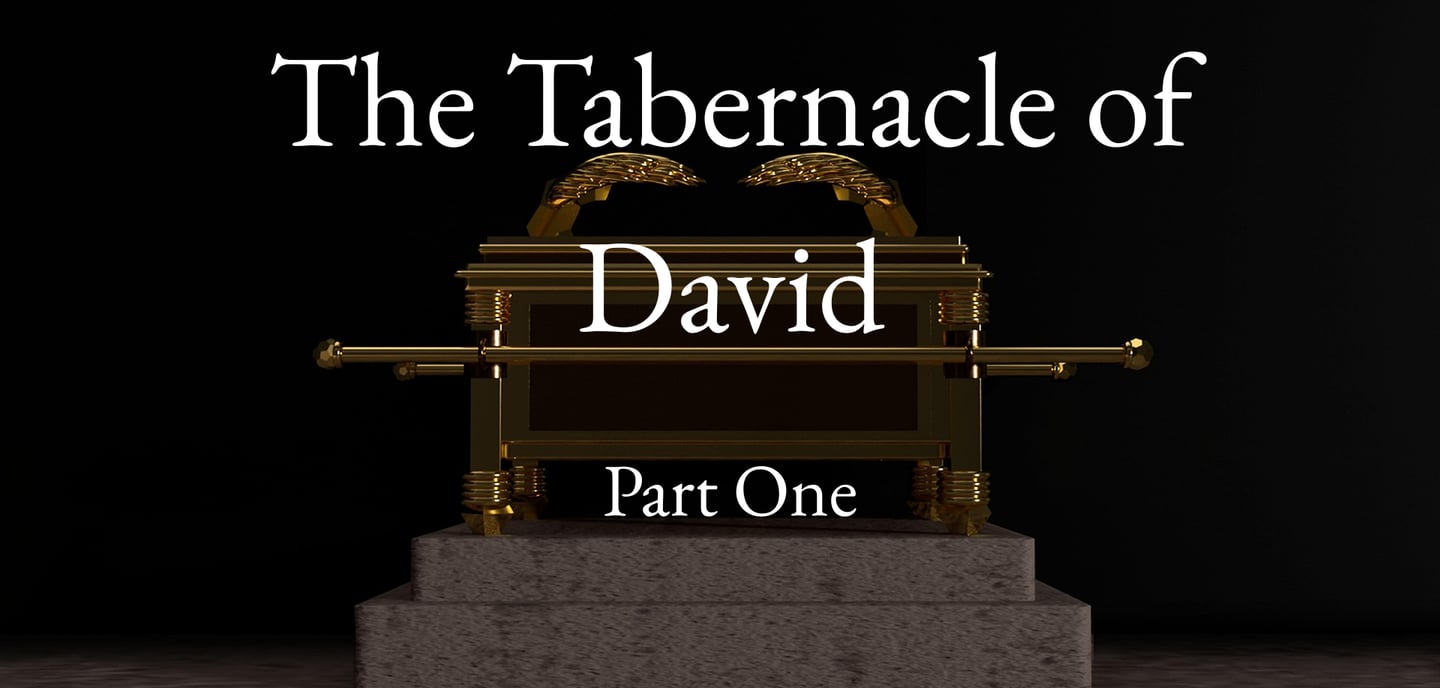
Central to this study is the Ark of the Covenant, for this is where the presence of God resided until the death of Christ. (Exodus 25:10-22) Wherever the Ark of the Covenant went, there also went the presence of the Living God on the earth. It is appropriate to begin by following the journey of the Ark after it was placed in the Holy of Holies behind the veil in the wilderness until it comes to rest in the temple built by King Solomon.
The Journey of the Presence of God
Following the Ark of the Covenant
When the Israelites completed the conquest and division of the land under Joshua (Joshua 18:1), Moses’ Tabernacle, or, the Tent of Meeting, was set up in Shiloh. There the prescribed sacrifices and familiar rituals would continue throughout most of the period of the Judges and into the time of the high priest Eli and the young prophet Samuel. It remained there for just over three hundred years until it was captured.
It would never return to the Tent of Meeting.
The Ark Captured by the Philistines
The Philistines captured the Ark of the Covenant from the Israelites during the Battle of Aphek, also called the Battle of Ebenezer. (1 Samuel 4) The Israelites, facing the Philistines, first suffered a defeat with about 4,000 men killed. They then brought the Ark from the sanctuary at Shiloh, hoping it would bring divine victory, accompanied by the sons of the high priest Eli, Hophni and Phinehas. In the subsequent battle, the Philistines decisively defeated the Israelite army, killing around 30,000, including Eli’s sons, captured the Ark, and took it as a trophy to their territory to Ashdod. Eli died upon hearing the news.
The Philistines held the Ark for seven months, (1 Samuel 5), during which they experienced plagues, described as tumors or hemorrhoids and an infestation of mice or rats. The image of their demon god, Dagon, fell on its face before the Ark, breaking into useless pieces. The Ark was moved to Gath and then to Ekron with comparable results. Realizing that keeping the Ark with them would eventually kill them all, they returned it to the Israelites on a new cart pulled by nursing cows whose calves were left behind. (1 Samuel 6)
[Personal observation: I find it amusing that it took seven months for these people to conclude that the Presence of Yahweh among their heathen and hedonistic practices was not “a good fit.”]
Miraculously, the cows overcame their instincts for their nursing offspring and headed straight to the field of Joshua at Beth-Shemesh on the Judean border.
Arrival and Placement at Kiriath-Jearim
After a sacrifice using the cows and the cart, some men of Beth-Shemesh looked inside the Ark, or handled it irreverently, resulting in a severe judgment: about seventy men were struck down dead. Fearing further disaster, the people of Beth Shemesh asked the men of Kiriath-Jearim to take it away.
The men of Kiriath-Jearim came, retrieved the Ark, and brought it to the house of a man named Abinadab on a hill. They consecrated Abinadab’s son Eleazar to guard and oversee the Ark. (1 Samuel 7:1) This established a semi-sacred custodial arrangement, with the Ark kept in a private home rather than a full sanctuary like the earlier one at Shiloh.
The Ark remained here for between 20 and 40 years. Twenty years is specified in 1 Samuel 7:2, however, the overall time the Ark remained there until King David brought it to Mount Zion was likely longer, probably spanning parts of Samuel’s leadership, Saul’s entire reign, and the early years of David’s rule, including his seven years in Hebron before capturing Jerusalem. The Ark may have been brought out with the Israelite army during Saul’s time, (1 Samuel 14:18), implying it was not entirely static but was still based at Kiriath-Jearim.
Events and Significance During This Period
The narrative emphasizes a time of spiritual malaise, (1 Samuel 7:2), as “the house of Israel lamented after the Lord.” The mourning was due to a sense of divine distance following the losses at Aphek/Ebenezer and the preceding corruptions by Hophni and Phineas at Shiloh. (1 Samuel 3:13) The Israelites would eventually respond to Samuel’s call for repentance and the putting away of foreign gods and win a great victory over the Philistines at Mizpah. (1 Samuel 7)
The Tent of Meeting was relocated to Gibeah after Shiloh’s destruction, but the Ark was not housed there, and the presence of God therefore did not dwell there. Prescribed sacrifices and rituals continued without the benefit of coming into the habitation of God on earth. The Ark’s prolonged stay at Kiriath-Jearim bridged the end of the era of the judges and the rise of the united monarchy under David.
David Retrieves the Ark of the Covenant
A Matter of Great Importance
Bringing up the Ark from Kiriath-Jearim to Mt. Zion was one of David’s early priorities after consolidating power as king over all Israel and capturing Jerusalem or Zion as his new capital, now to be called the “City of David.” The event would make Jerusalem not only the political but also the religious center of Israel and restore proper worship after the Ark’s long neglect since the days of Saul.
Timing and Context
David had reigned seven years in Hebron over Judah and then been anointed king over the united tribes of Israel. He had defeated the Jebusites to take Jerusalem and won key victories against the Philistines. The Ark remained at Abinadab’s house on the hill in Kiriath-Jearim, about 7–9 miles west of Jerusalem. David noted that Israel had “not inquired at it since the days of Saul,” highlighting a period of spiritual neglect.
Learning God’s Way the Hard Way (2 Samuel 6 and 1 Chronicles 13-16)
David consulted with his leaders and gathered a large assembly of Israelites, including 30,000 chosen men. They went to Kiriath-Jearim to bring up the Ark, which was still in the house of Abinadab. Abinadab’s sons Uzzah and Ahio guided it. The Ark was placed on a new cart. This mirrored the method the Philistines had used earlier and was divergent from Mosaic instructions.
The people celebrated with music, singing, and all their musical instruments: lyres, harps, tambourines, cymbals, and trumpets. As the procession moved across the threshing floor of Nacon, the oxen stumbled. Uzzah reached out his hand to steady the Ark and was immediately struck dead by God. David became angry and afraid, naming the place Perez-Uzzah, “outbreak against Uzzah.” He halted the move, fearing further judgment, and left the Ark at the house of Obed-Edom nearby.
The Ark remained there for three months, during which God blessed Obed-Edom and his entire household. This contrast, judgment on irreverent handling versus blessing on the presence of the Ark, convinced David to try again. But this time, he wisely consulted the Scriptures first.
According to the biblical text and later reflection (especially in 1 Chronicles 15), the failure stemmed from not following God’s explicit instructions for transporting the Ark. (Exodus 25:12–15; Numbers 4:15; Deuteronomy 10:8) It was to be carried by Levites using poles inserted into its rings on the sides and no one was to touch the Ark itself. David initially treated it more like a Philistine trophy or common object rather than adhering to the Levitical regulations. This underscored the holiness of God and the danger of approaching Him casually or presumptuously, even with good intentions. David learned from the incident. In the second attempt, he emphasized proper procedure.
The Ark Comes to Mount Zion
Encouraged by the blessing on Obed-Edom, David prepared a place on Mount Zion and pitched a tent for the Ark. He instructed the Levites to sanctify themselves and carry the Ark correctly on their shoulders with poles. Sacrifices were offered after every six steps as a sign of reverence. The procession was joyful and grand: David danced “with all his might” before the Lord, wearing only a linen ephod, a priestly garment. Shouts, trumpets, and music accompanied the Ark into the City of David.
The Ark was placed inside the tent David had prepared. He offered burnt offerings and peace offerings, blessed the people, and distributed food to the assembly. Michal, David’s wife and Saul’s daughter, watched from the wrong side of her window, as she should have been a participant, rather than a spectator in this great praise and worship service. She despised David in her heart for what she saw as undignified behavior, leaping and dancing publicly. Later, she confronted him sarcastically. David replied that he would humble himself even more to honor the Lord, and the text notes that Michal had no children afterward.
Bringing the Ark to Jerusalem united political power with God’s presence, the “footstool” of His divine throne where He was enthroned between the cherubim. The event highlighted obedience to God’s commands over human enthusiasm. David modeled zealous yet regulated devotion. It showed his heart for God, willing to celebrate extravagantly and learn from mistakes.
The Ark has finally found a resting place among God’s covenant people. In our next study, “The Tabernacle of David, Part Two,” we will examine the startling changes they experienced as their worship was made new in the presence of the Lord.
Connect
Larry@everydaygracematters.com
© 2025. All rights reserved.