To Be Like Christ
Blog post description.
3/5/20264 min read

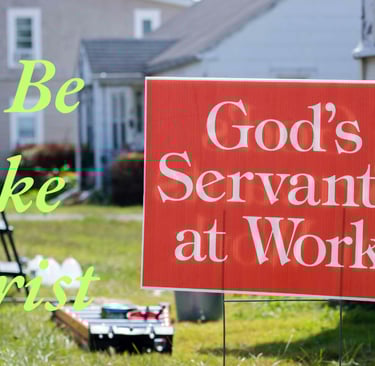
Obviously, the priority of any Christian is to become more like Jesus. We attend church, we try to live good lives, and we attempt to read our Bibles and pray every day, doing so with varied success. Our consciences, blended with the presence of the Holy Spirit since our salvation, create in each of us a desire to be the kind of person that our Savior demonstrated we should be. Jimmy and Carol Owens included a chorus in their musical, “The Witness” in 1979, a simple prayer that says:
Lord, make me like you, please make me like you,
You are a servant, make me one, too.
O Lord, I am willing, do what you must do,
To make me like you, Lord, please make me like you.
It is an easy chorus to sing and expresses a desire planted deep within every Christian. There is, however, a phrase that is paramount if we are to achieve our sacred yearning: “You are a servant.” Indeed, Jesus exemplified servanthood and taught us this principle repeatedly so that we would eventually come to understand it and could, in fact and in action, become more like Him.
Philippians 2:5-7
“Have this mind among yourselves, which is yours in Christ Jesus, who, though he was in the form of God, did not count equality with God a thing to be grasped, but emptied himself, by taking the form of a servant, being born in the likeness of men.”
The word translated as servant in this passage is from the Greek word “doulos.” In classical and Hellenistic Greek, including New Testament times, this word specifically denotes chattel slavery and total ownership. This is not always the case when you read the word servant throughout the New Testament, but it is critical to understand in the life of Jesus that He took the form of a “doulos,” a slave.
Consider the stark contrast offered here. Jesus Christ was always and forever in the form of God, intrinsically sharing the glory and status of the Almighty. When He came to earth as human, He did not come as a human king, or a persona of renown and fame. He traded the divine form for the form, (same Greek word), of a slave. He came from the form of the preeminent, supreme Lord of all and took the form of the lowest social and functional status in the Greco-Roman world!
The Surrendered Life
To live the Jesus life and to be a servant means we must change shape. We have a fundamental obligation to surrender our individual rights and autonomy just as one who is the property of another. But how can I give up my rights? Why, that is anti-American! Individuality and the entitlement to be who I am is the staple of modern Western philosophy. And what about my autonomy? Now you are taking away my self-determination and personal choice. You cannot be serious. We have an ideology that has become a massive movement motivating both political strategy and moral behavior based solely on “pro-choice.”
Are you still singing the simple prayer chorus with which we began, or have I lost you? To be Christ-like, to be Christian, is to take a shape that violates every notion we have of self-sufficiency, self-reliance, and self-rule. This is the Jesus model. This is what He did for us, challenging and expecting us to do it for others. This is His way: not self-sovereignty but self-subjection.
He came humbly and poor. He was born where animals were sheltered. He came completely dependent upon others for life itself. When He knew the time of His suffering had come, He put a towel around His waist and washed the feet of Judas Iscariot.[1] Ultimately, He succumbed to an execution reserved for a criminal slave. This was His positive submission for our redemption.
To Be Like Jesus
Leonard, the exhausted American missionary, boarded the overcrowded train that would carry him inland from the coast of India back to the little house he used as a home-base for his ministry. The heat was oppressive but hardly noticeable when compared with the smells of sweaty, unwashed bodies pressed against one another. As the train rumbled along, he eventually needed to use the latrine that he knew would be meager at best. What he discovered was far worse than he could have conceived. The single metal toilet was covered in excrement and urine, as was the floor around it. There was a sink, but the faucets were coated with muck and filth that was not readily recognizable. He held his breath, took care of his business, and made his way back to his seat.
A few moments later, Leonard noticed that two women across the aisle from him were in obvious distress. They addressed one another in brief, urgent sentences he was unable to hear over the pandemonium of loud voices and the racket of steel wheels on rails. As he observed them, he noticed anxious glances over their shoulders toward the rear of the car. He began to understand that their dilemma had to do with the condition of the lavatory which, for them, was an unworkable situation.
Leonard rummaged through the small satchel he carried. He found little that would be practical but took what he thought he could use and returned to the foul, offensive stall at the rear of the carriage. He used his bar soap, some handkerchiefs and a couple of shirts to wipe away the human waste, his toothbrush and paste to shine the faucets and then sprayed after-shave around, doing his best to deodorize the place. He then went forward and informed the distressed women that the bathroom was now suitable for use.
When they came back to their row, they conveyed their extreme gratitude through bountiful tears. Leonard shared the Gospel of Christ, and they promptly and joyfully received the good news, having already been introduced to the person of Christ through His servant. For this was Jesus Christ’s example to all of us, calling us to humble, others-focused living.
“You are a servant. Make me one, too.
O Lord I am willing, do what you must do,
To make me like you, Lord, please make me like you.”
[1] John 13:3-5
Connect
Larry@everydaygracematters.com
© 2025. All rights reserved.